Veggie Gardens
Published
November 30, 2026
Author
The Searles Gardening Team
Wondering when to fertilise your garden in Australia once the weather heats up? Summer is when veggies, pots, lawns and fruit trees are growing hard, so they use plenty of food. The trick is to feed little and often, always on moist soil, and to hold off during a heatwave. Searles' own summer advice is that "less is more": a light application of a balanced slow-release fertiliser every six to eight weeks is plenty, topped up with a liquid feed every one to two weeks while plants are actively growing.
You don't need a shed full of products to feed your garden well. Most gardeners only need two types, and they do different jobs.
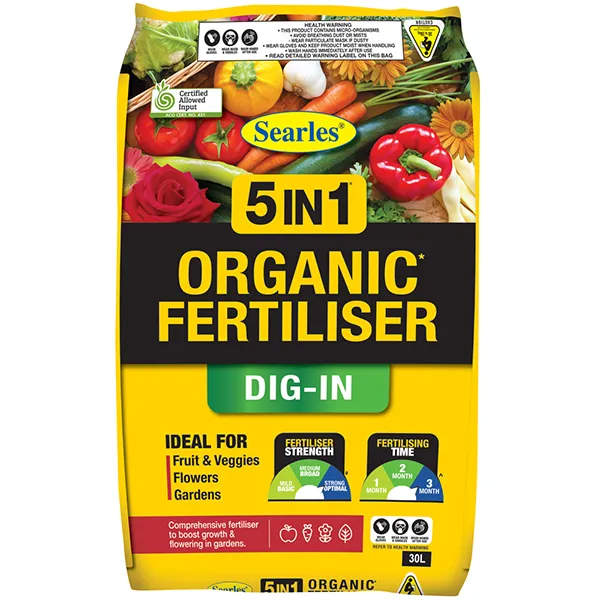
Slow-release (granular, dig-in or pellets) releases nutrients over time, so you apply it less often. Searles 5 IN 1 Organic Fertiliser is a dig-in organic fertiliser made from cow, fowl and sheep manures, mushroom compost, zeolite and blood and bone, plus added trace elements and minerals. It also helps retain soil moisture and keep roots cool, which is handy in summer. It's BFA certified organic. If you prefer something easy to scatter, 5 IN 1 Organic Fertiliser Pellets are a long-lasting formula for flowers, veggies, fruit, lawns, shrubs and trees.
Liquid and soluble fertilisers are quick acting and taken up through leaves and roots. Searles' fertilising guide says warmer months are when liquid fertilisers become a key support. Options include:
A simple summer routine: a slow-release base in garden beds, plus a regular liquid top-up for hungry plants.
Summer veggies like tomatoes, zucchini and cucumbers grow fast and fruit heavily, so they're among the hungriest plants in the garden.
Fruiting crops rely on potassium for good fruit, while leafy greens need nitrogen for strong leaves. That's why tomato and veggie foods are worth using once flowers and fruit appear.
Pots dry out quickly in summer and nutrients wash through with every watering, so they need a little extra attention.
Start with a quality mix. Searles Premium Potting Mix includes controlled-release fertiliser for eight months of feeding, plus a rapid-response fertiliser that feeds straight after planting. That gives potted plants a solid base.
On top of that, a liquid or soluble feed every one to two weeks during active growth keeps flowers, herbs and veggies in pots going strong. Flourish soluble plant foods are suitable for pots and gardens.
One thing to avoid: 5 IN 1 Organic Fertiliser (Dig In) isn't recommended for pots or for mixing with potting mix. It's designed for garden beds and lawns.
Lawns can look tired by mid-summer, but feeding at the wrong time can do more harm than good.
Searles Lawn Food is an organic-based food for all lawn types, with high nitrogen, low phosphorus and added iron. For larger areas, 5 IN 1 Hose-on is an easy way to feed while you water and covers about 50 square metres. Check the pack for how often to reapply.
Fruit trees are busy setting and swelling fruit in summer, so steady feeding helps.
To sum up when to fertilise your garden in Australia over summer:
You don't need to get it perfect. Start with a simple routine, watch how your plants respond and adjust as you go. For more feeding basics, read Searles' guide to fertiliser basics and when to feed, and explore the full Searles fertiliser range.
In summer, a light application of a balanced slow-release fertiliser every six to eight weeks is enough. Fast-growing plants and pots also benefit from a liquid feed every one to two weeks while they're actively growing.
Avoid fertilising during a heatwave or when plants are stressed, and wait until conditions ease and plants recover. Always water thoroughly before you feed, especially in hot or dry weather.
Slow-release fertilisers release nutrients over time, so they need less reapplication. Liquid fertilisers act quickly and are best applied every one to two weeks during active growth.
No. 5 IN 1 Organic Fertiliser (Dig In) is designed for garden bed soils and lawns, and isn't recommended for pots or mixing with potting mix. For pots, use a quality potting mix with built-in fertiliser and add a liquid or soluble feed such as Flourish.
Plant into soil enriched with fertiliser, then start a liquid feed about three to four weeks after planting once new growth appears. Through summer, feed every one to two weeks with a liquid such as Flourish Tomato, Vegetable & Herb.
Ready to give your garden a summer boost? Ask for Searles 5 IN 1 Organic Fertiliser and Flourish at your local garden centre, or find your nearest Searles stockist online.
Found this article helpful?
Find where to buy these recommended Searles products near you!